Heavy Horses
at the
East of England Show.
|
The Showground, Peterborough.
6th - 8th July 2012.
by Rosemary Cooper.
This show has a comprehensive list of classes for heavy horses and the organisers had the excellent idea of moving it into the gap left by the demise of the Royal Show, resulting in a good entry. Sadly the weather was unkind, and deep mud resulted in some classes being modified or cancelled.
The 2012 British Festival of the Working Horse took place at the show, and the first day marked a visit by Prince Charles, who is patron of this Festival as well as being Patron of the British Horse Loggers and of the British Horse Loggers Charitable Trust. He spent some time touring the area, inspecting horses and discussing their work with the handlers. Doug Joiner, the man behind the idea and one of the main organisers was very excited that Prince Charles visited the event. ‘He shows great interest in the viability of working with horses and pioneers their use,’ said Doug. ‘The horsemen and women showed him the latest in new developments as well as their highly trained horses.’
These horses are all stocky but short, so able to plough as well as excel at logging. They included a Suffolk Punch, a Comtois, a lovely golden dun Ardennes mare, and a black Brabant stallion who worked with one rein. Imported horses were in the majority, so I was told that since modern Shires are too tall to plough, people who want working horses normally use cobs. (Think of the angle at which the plough enters the ground; the taller the horse, the steeper the angle...)
Logging horses are ideal for work in mixed native woodland. If thinning is done by horses, the gentle movement of the horse over the ground helps seed to germinate if there is not much regeneration. Horses can also scarify the ground, which does no damage to plants such as bluebells, now a threatened species. In mixed woodland horses finish work at the end of March, though plantation work goes on longer. A horse recently removed a line of redundant telegraph poles on a triple SSI site, where the only alternative would have been to use a helicopter. Currently English Heritage has asked for work on moorland and woodland with Roman and Iron Age forts to be done with horses.

In-hand Percheron Champion Willingham Etoile.
It’s always a treat to see a Willingham Percheron, as I find that any horse bred by Gordon Bailey is immediately recognisable as such, being well over 18 hands tall and powerfully built, but with the quality of an aristocratic riding horse. As an artist, I would be hard-pressed to invent a more imposing horse. These looks are set off to perfection by dapples that are almost star-shaped in places, and when a Willingham mare appeared on Facebook, people suggested that a horse with so many stars should be called Galaxy! So it was no surprise that the Percheron championship went to Gordon Bailey’s Willingham Etoile, one of the elite band of siblings by Ryan’s Day Granitdier out of Willingham Phoebe. At the age of 10, she is considerably paler than when I last saw her, but it will still be some years before she is white.
Loving the beauty of Willingham Etoile didn’t stop me from admiring the other horses in the class. Five-year-old Hales Helen, named after Helen of Troy, is a quality mare who is still black except for her iron grey head. She is by Ryan’s Day Stewart out of Hales Uni, the first Percheron to be the Royal Show Supreme In-hand Champion before Etoile’s famous sister, Willingham Marie, won the title twice. Tom Henfrey’s Park Samantha, by the short-lived K D S Torin, is the black Canadian type of Percheron, and at an earlier show I enjoyed the opportunity to sketch her. Guela Leedham’s Davgue Rosie May, by Comberton Thomas, was the only mare to have a foal at foot, though Etoile’s yearling filly by K D S Torin, Willingham Snowy, headed the yearling class. As Guela Leedham pointed out to me, Rosie May was the only mare to have hocks set close behind.
Champion Shire in hand was Jim Yates’ three-year-old filly Sheepwash Derbyshires Eventide. Jim was very disappointed at Derbyshire County Show when Evie finished first in the SHOYS qualifying class, only for Jim to discover that he had forgotten to enter her on paper. He made up for the omission by winning the qualifier here and had a great show, also taking first with his two-year-old owerslane Katy, who is almost a look-alike for Evie. Katy also won the award for the best placed junior Shire bred by the exhibitor.
Glenn Cass had a good show in-hand, taking reserve champion in Shire and Suffolk breed classes, Reserve Champion Shire was his black gelding Grovemere Lucky Boy and Reserve Champion Suffolk was his Kentwell Paigale. (a Suffolk word for cowslip.) Champion Suffolk in hand was Mr Wager’s Lagan Oswald, a three-year old gelding by Euston Malachite out of Colony Orchid II. Mrs Hoskin’s mare Auchenhamper April Misty Morn only came third in her class but demonstrated fertility many Suffolk breeders must envy, with three of her progeny being present. She had a foal at foot by Whatton Albert and was beaten in her class by her own four-year-old daughter, Shotley Field Golden Rose, The number was made up to three by Golden Rose’s yearling sister Pickworth Golden Poppy. Both these two are by Golden Grandchild.
The showground being too far south for many Clydesdale exhibitors, there are no Clydesdale classes as such. Instead there is a general class in which Clydesdales of both sexes and all ages compete against horses of Shire type, with a promise of splitting the class if there are enough entries. Winner was Messrs Burks and Edwards’ Woodhouse Mr Brightside, a two-year-old gelding bred by Martin Fountain, by Woodhouse Lucky Strike out of Woodhouse Sunflower.
The young handler class went to Guela Leedham’s son, 15-year-old Stephen Leedham, who is unbeaten in his last four classes. At the last Royal Norfolk Show he won both Shire and Percheron classes for young handlers.

Groom Stephen Smith with John Goodwin's team of Shires.
The first of the comprehensive schedule of turnout classes was the pairs class, enlivened when John Medhurst’s young Shires gave him the ride of his life. They decided to go for a gallop round the ring, and the number of circuits depends on who is telling the story, but when the dray rounded a corner on two wheels, John is said to have leant over like a scurry driver! Winners of the class were Tom Henfrey’s black Canadian Percherons, Casey and Cole, driven by Ron Brewster. Roger Roper’s Dove Percherons, also perfectly matched Black Canadians, finished second. Third was John Goodwin and his bay Capespan Shires, who later won the teams, singles and Driving Championship, and came second in the tandem class. ‘I’ve got a five year old brave enough to be a leader’, said John.
In the singles class Owen Garner drove Hales Faunus (Freddy), who at the age of six is still iron grey with an almost white mane and tail, to second place, separating John Goodwin’s Shire from Gawin Holmes’ white-faced Clydesdale Jerry, in third place. In fact, apart from John’s Shires and Gawin’s Jerry, Percherons filled the first three places in every trade class.
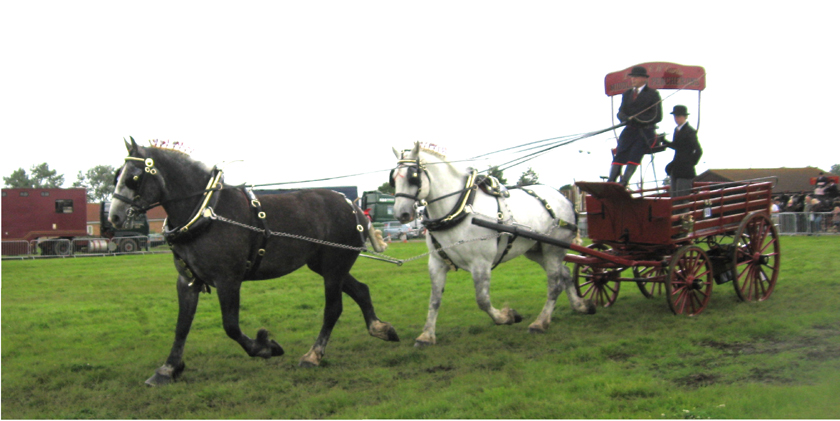
David Curtis' tandem with Percherons Eros (leader) and Ron (wheeler).
Ron Brewster, placed third in this class after John Goodwin, said: ‘I always get a bit of a buzz when I’m driving a tandem.’ He was second in the teams class, with high-stepping Cole as the lead horse while Casey and young team-mate Atlas were wheelers. Third place went to Owen Garner with Freddy leading two younger horses, Hector and Helen.
‘I’m looking for those things you normally can’t see,’ said Mr Peacock, who had a long distinguished driving career. ‘So are you poacher turned gamekeeper?’ asked the commentator. ‘You could say that, agreed Mr Peacock, laughing.

The winning agricultural turnout, Jester the Percheron and Emma Scotney.
The agricultural class went to Emma Scotney, driving the Fuller family’s handsomely dappled Percheron, Jester, to a 1911 Wiltshire Boat Waggon. They beat Mr Smith with the Suffolk Colony Millennium, who stood at stud for some years before being gelded, and Andy Thompson with his Suffolk gelding Craikhowe Hall John Boy. Maggie Smith and her Shire Patrick filled fourth spot.

Jane Wordswoth's Comtois allrounder, Major, in the single trade turnout class.
And yes, the sun did shine sometimes!
The class for ladies and gentlemen’s two wheeled carts was won by Wendy Toomer-Harlow, who is very successful in these classes with her blue-eyed bay Shire Leverton Quality Lad (Bill). The single obstacle driving class was cancelled due to deep mud, but next day the pair class went ahead in a different ring. It was won by Jane Wordsworth, demonstrating the versatility of her athletic little Comtois horses. The flaxen manes and tails of Comtois, with their bright chestnut coats, make them look almost like Palominos, or to quote Jane, like ‘Haflingers on steroids’. Her Major was among the working horses inspected by Prince Charles on Friday, then with team-mate Rodeo won the obstacle class on Saturday, and finally finished second in the ridden class on Sunday.
Results.
Judge Mr John Peacock.
Turnouts.
Trade. Unicorns & Teams of 4 – 1 & ch, Capespan UK; 2, T Henfrey; 3, E Garner & Sons.
Pairs – 1, T Henfrey; 2, R Roper; 3, Capespan UK.
Singles – 1, Capespan UK; 2, E Garner & Sons; 3, G Holmes.
Tandem – 1 & res ch, D Curtis; 2, Capespan UK; 3, T Henfrey.
Ladies & Gents Carts – 1, Mrs W E Toomer-Harlow; 2, D Curtis; 3, Mrs H Keeble.
Obstacle driving.
Single – cancelled because of ground.
Pairs – 1, Mrs J Wordsworth; 2, Fullers Brewery; 3, Mrs H Keeble.
Agricultural turnouts.
Single – 1, R & SA Fuller; 2, P T Smith; 3, A L & C Thompson.
In-hand
Shire types or Clydesdales – 1, M Burks’ & S E Edwards' Woodhouse Mr Brightside; 2, Miss S K Collins' Aussie Savannah Sunrise; 3. G I Holmes’ Walton Royal Sovereign.
Shire or Shire cross gldng – 1 & res ch, G Cass’ Grovemere Lucky Boy; 2, G I Holmes’ Westside John B; 3, Miss J Locke's Aussie Moonlight Eclipse.
Barren mare, 3–y–o & over – 1, ch & ch female, T J Yates' Sheepwash Derbyshires Eventide; 2 & Shire Horse Society’s silver spoon, G Robinson’s Metheringham Upton Teasel; 3, K & S Hasemore's Snowhill Dancing Queen.
2–y–o – 1 & best jnr Shire bred by exhibitor, T J Yates' Cowerslane Katy; 2, G Robinson’s Metheringham Upton Tulip; 3, G Ward’s Decoy Royal Sunrise.
Yrlng – 1 & best Shire bred by exhibitor within 40 miles radius, B Wright's Old Croft Charisma; 2, Mrs M Prior's Hainton Sophie.
Brood mare – 1, Mrs G M Leedham's Silver River Lady.
Foal – 1, Mrs G M Leedham's Silver River Princess.
SHOYS qualifier – 1, T J Yates' Sheepwash Derbyshires Eventide; 2, G Robinson’s Metheringham Upton Teasel; 3, Mrs G M Leedham's Silver River Lady.
Best Junior Handler – 1, Stephen Leedham; 2, Evie Lund; 3, Abbie Starling.
Suffolks in-hand.
Judge Mr J Purse.
Gldng, 3–y–o & over – 1 & ch, A Wager's Lagan Oswald; 2 & res ch, G Cass’ Kentwell Paigale; 3, A L & C's Craikhowe Hall John Boy.
Mare, 3–y–o & over – 1, P T Smith's Shotley Field Golden Rose; 2, Miss L M Miller's Block Fen May Queen; 3, Mrs A Hoskin's Auchenamper April Misty Morn.
Foal – 1, Mrs A Hoskin's colt out of Auchenamper April Misty Morn.
Yrlng or 2–y–o (excluding 2-y-o colts.) – 1, Mrs A Hoskins’ Pickworth Golden Poppy.
Percheron in-hand.
Judge Mr J Purse.
Gldng, 3 y-o & over – 1, E Garner & Sons' Hales Faunus.
Mare 3-y-o & over – 1 & ch, E Bailey & Sons’ Willingham Etoile; 2 & res ch, E Garner & sons' Hales Helen; 3, T Henfrey’s Park Samantha.
Foal – 1, Mrs G M Leedham's Davgue George.
Yrlng or 2–y–o (excluding 2-y-o colts.) – 1, E Bailey & Sons’ Willingham Snowy; 2, B Hall's Halls Lulu.
Ridden (Judge Mr S Somers) – 1, R S Green's Admergill Buscot; 2, Mrs J Wordsworth's Major; 3, Mrs T Fryer's Sans Peur Suzi.